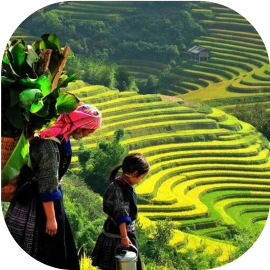
A long, sweeping valley south-east of Sapa Town, carved by the Muong Hoa stream and lined with the terraced rice fields that made Sapa famous.
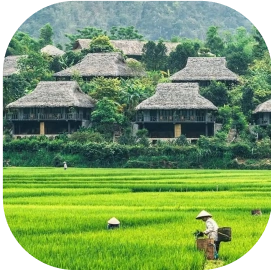
Muong Hoa Valley runs for kilometres below Sapa Town, following the Muong Hoa stream between the peaks of the Hoang Lien Son range. Its slopes are stepped with rice terraces built and maintained by generations of Black H’mong, Giay and Red Dao families, and the valley floor is dotted with villages such as Lao Chai, Ta Van and Hau Thao.
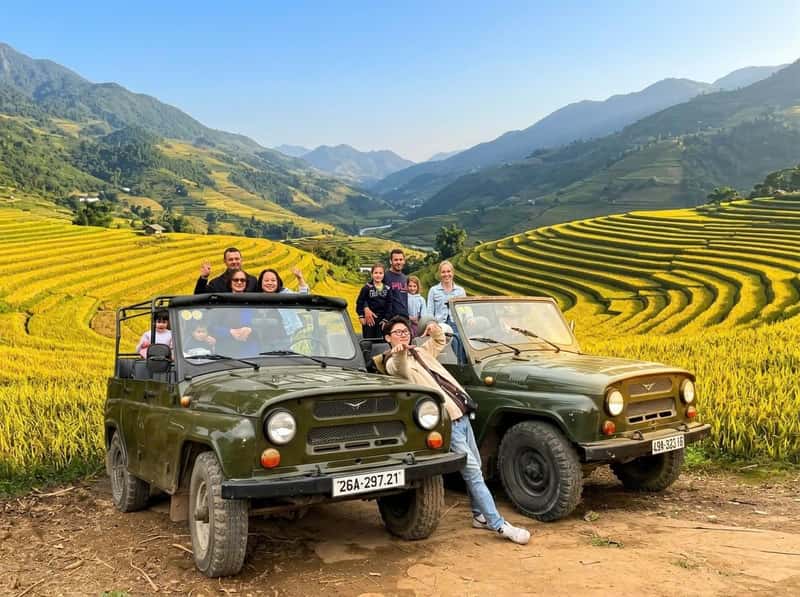
The valley changes character through the year: mirror-like flooded terraces in spring, bright green rice in early summer and golden fields just before the harvest. Mist often fills the valley in the morning and lifts to reveal layer after layer of terraces — one of the classic views of northern Vietnam.
Muong Hoa is also home to the Sapa ancient carved rock field, a group of boulders engraved with patterns and figures whose age and meaning are still debated by researchers. It is recognised as a national heritage site.
Highlights of Muong Hoa Valley
- Panoramic viewpoints over layered rice terraces
- Villages of Lao Chai and Ta Van along the valley floor
- Ancient carved rock field near the valley road
- Streams, bamboo forest and suspension bridges
Things to do
Stop at the valley viewpoints
The road from Sapa down into the valley passes several lookouts with sweeping views over the terraces — best in the morning.
Walk between Lao Chai and Ta Van
An easy village walk along terrace edges and paths is the classic way to experience daily life in the valley.
See the ancient carved rocks
Look for the engraved boulders scattered through the fields along the valley road.
Coffee by the stream
Stop at a stream-side café such as Nhà Bên Suối to rest and listen to the water.
Plan your visit
How to get there
The valley begins about 8–10 km south-east of Sapa Town along the road to Lao Chai and Ta Van. The road is steep and winding; most visitors go by Jeep, motorbike (with a local rider) or on a guided trek.
Best time to visit
April–May for water-filled terraces, June–August for green rice and late August–September for golden fields before the harvest. Winter (December–February) is cooler and often misty, with quieter trails.
Local tips
Mornings are usually clearer; mist often rolls in during the afternoon.
Wear shoes with grip — village paths get muddy after rain.
Ask before photographing people, especially children.
Map
Questions about Muong Hoa Valley
Can you visit Muong Hoa Valley without trekking?
Yes. Our Jeep and motorbike tours drive down into the valley and include only a short, easy walk through the villages.
When is harvest season in Muong Hoa Valley?
The rice usually turns golden in late August and September, depending on the weather each year.